

Home

What we do
Each experiment is slightly different, but all of our research is centered on how language is processed in the brain. These are the methodologies that we currently use:

1. Behavioural experiments
In these experiments, participants are presented with different stimuli (e.g. visual and/or audio through headphones) and will have to make a decision whether what they have just heard or seen is a real word or not.
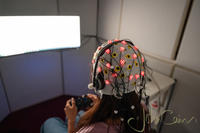
2. EEG experiments
The main difference between the EEG experments and the behavioural experiments is, although participants may be doing essentially the same task. Participants wear an electrode cap to enable the measurements of electrical impulses on the scalp.
These experiments usually take a little longer due to the preparation time.

3. Eye tracking experiments
Eye tracking experiments record the movement of a participants eyes when they are reading. The task is usually very simple but participants may be surprised how their eyes move around when reading.
4. Speech production experiments
These experiments are used to investigate the process of speech planning and usually involve participants reading out words or sentences while being recorded.

